Stara Loka Bell Simulation
A program that takes the 3D scan of a bell, or only its rib, computes how the bronze vibrates and how the air carries it away, and plays what a blow at any point sounds like. This is its full report on stara-loka_zaprt.stl: every picture is computed from the scan, every sound from the model. Nothing here is a recording.
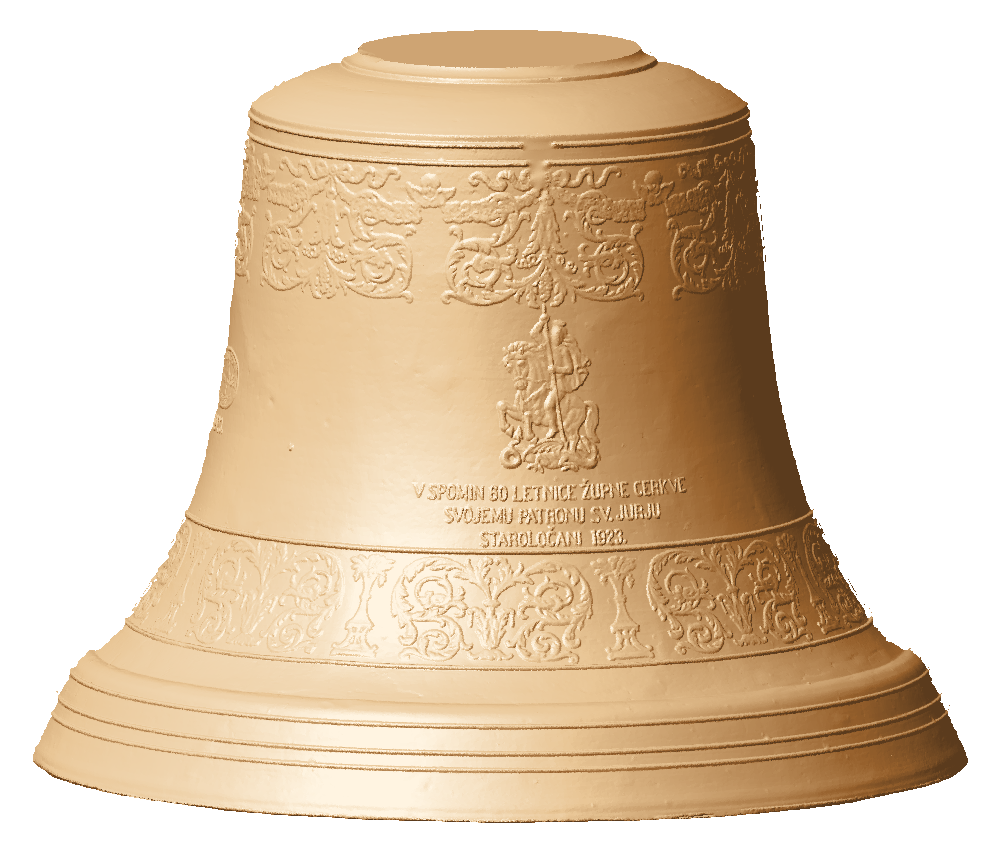
- Bronze in the scan
- 2,432 kg
- Mouth diameter
- 1,658 mm
- Height without crown
- 1,264 mm
- Thickest wall
- 122 mm
- Strike note
- B♭3 +49 c
- Hum rings for
- 81 s
The question, and the short answer
A je AI že tako daleč, da bi napisal program, ki bi iz rebra zvona ali celega 3D scana (z neidealnostmi zaradi svetnikov, jajčavosti itd.) izračunal zvon? Če ja, bi lahko tudi obratno: zvonove bi 3D skeniral, jih dal v program in program bi kazal, kako naj jih struži za uglaševanje. Da, oboje. Program iz rebra izračuna alikvotne tone v nekaj sekundah, iz celega scana pa tudi dvojne tone (utripanje) zaradi zamika jedra, reliefov in obrabe. Obratna smer deluje enako: program izračuna, kje in kako globoko je treba stružiti. Absolutna višina tona je brez enega posnetka pravega zvona negotova za približno pol tona navzgor ali navzdol, razmerja med toni pa veliko manj.
- From the rib alone, the partials come out in seconds.The round bell with this rib has its nominal at 479.5 Hz and its strike note at 239.8 Hz, a B♭3 about 49 cents sharp, as expected for a 2.4 t bell. Against the nominal the hum is 25 cents flat, the prime 47 cents sharp, the tierce a minor third to within 2 cents and the quint 32 cents flat. It is close to an octave bell, with a sharp prime.
- From the whole scan, the warble comes out too.Every pair of modes is split by 0.07 to about 1 Hz. The hum beats once every 6.5 s, the prime every 2.3 s, the tierce every 3.5 s and the nominal every 2.6 s; all splits are under 3.1 cents, below the roughly 6 cents where warble starts to be heard as a fault. How deep each beat is depends on where the clapper lands and where you stand.
- The reverse direction works on the same model.Asked to make this bell a true octave bell (hum, prime and tierce exact), the solver turns 77 kg off the inside, at most 8.1 mm deep, in two zones: under the shoulder to bring the prime down, and on the sound bow to bring nominal and tierce down to the hum. The strike note falls by 34 cents. That is an illustration of the method, not a proposal for this bell.
- What it cannot know from the scan.The stiffness of this particular bronze: until one recorded partial fixes it, every frequency above carries about ±50 cents, all in the same direction. The head and crown, which the scan closes with a flat plate: they move the hum by up to 43 cents. The intervals between the other partials should hold to 10–20 cents. No published study has checked a scan-based model against a bell heavier than about 30 kg, so a recording of this bell is the test that matters.
The scan
- The wall is about 6 mm thicker on one side than on the other.Round the waist the wall thickness varies once per turn by ±2.9 mm (thickest near 250°, thinnest near 70°): the core sat about 3 mm off-centre in the mould. Outer and inner surface are each round to about 0.7 and 0.5 mm (ovality). Neither splits any pair; see the table further down.
- Five clapper wear marks, up to 3 mm deep.They sit 83–92 mm above the lip, exactly where the wall is thickest (123 mm), at 31°, 184° and 194° (a double mark), 253° and, shallower, at 86°. Two pairs of roughly opposite marks: the bell has been turned on its yoke at least once. The simulated clapper strikes on these marks.
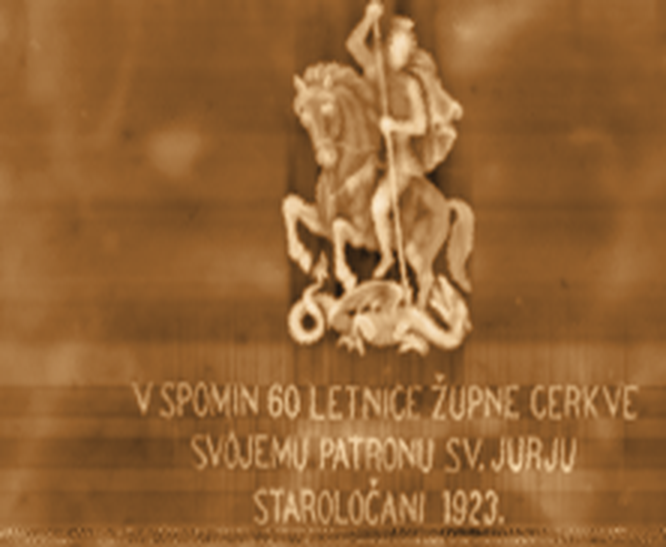
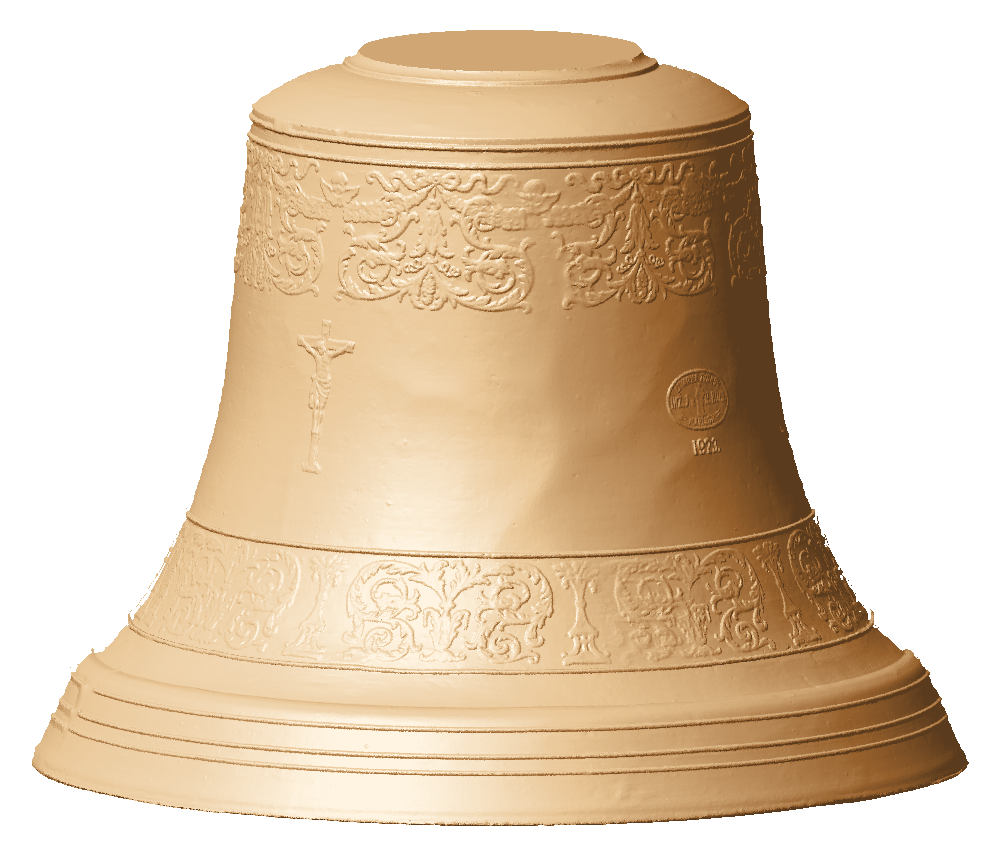
- The reliefs are in the model, down to the lettering.The scan is fine enough to read the dedication: V spomin 60 letnice župne cerkve svojemu patronu sv. Jurju Staroločani 1923. St George on horseback sits at 0°, a crucifix at 185°, the founder's oval mark with the year at 270°, and two friezes run all the way round. Each stands 2–5 mm proud and is carried into the 3D model as local thickening, averaged over about 10 mm.
- The head is not really in the scan.Inside a radius of about 280 mm the top is a flat cap added to close the mesh; the crown and the true head thickness are missing. The model treats the cap as bronze and lets the bell hang free.
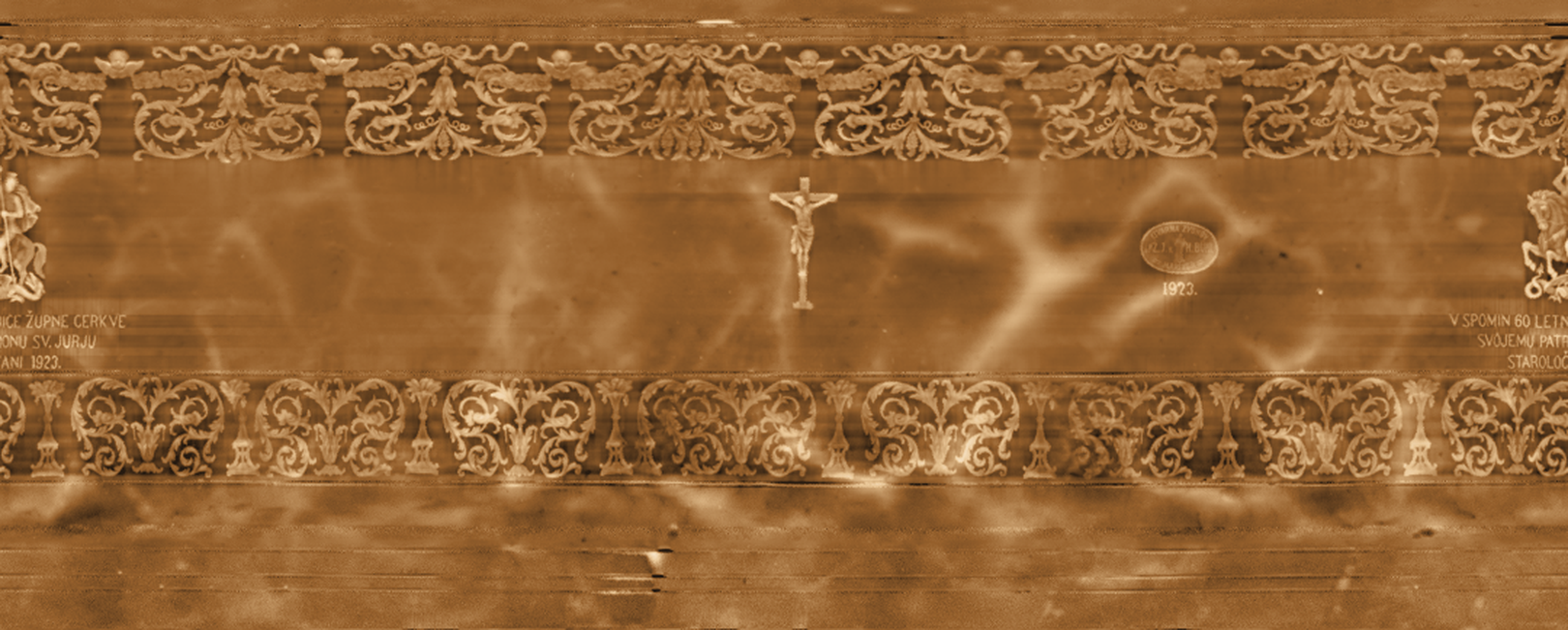
The outer surface unrolled: azimuth across, lip at the bottom, shoulder at the top. Brightness is height above the smooth wall, so the picture is a rubbing of the reliefs made from the scan. The pale veins are casting texture a fraction of a millimetre high.
How round the bell is. Each surface is measured against its own best circle at every height; the bars are the average amplitude of each harmonic over the waist. Harmonic 1 is the core sitting off-centre, 2 is ovality, the higher ones are reliefs and unevenness. Only harmonics 4, 6 and 8 split the pairs of the lowest partials.
The partials
Each partial is really a pair of modes with the same shape, one turned against the other round the bell. On a perfectly round bell the two have the same frequency. On this one they differ by a fraction of a hertz, and the pair beats.
| Partial | m | Hz (the pair) | Note | vs ideal | Split · beat period | T60 | ζ rad ×10⁴ |
|---|
Computed with E = 103 GPa, ρ = 8600 kg/m³, ν = 0.34. m is the number of nodal meridian pairs; I-7, II-5 and so on follow Lehr's groups. T60 is the time to fall by 60 dB. ζ rad is the computed radiation damping ratio; the material adds 0.9 ×10⁻⁴ to every partial (literature value for bell bronze).
Inner tuning: cents from the ideal ratio to the nominal (hum 1:4, prime 1:2, tierce a minor third above the prime, quint, superquint 3:2, octave nominal 2:1). The green band is ±10 cents. These intervals do not depend on the stiffness or density of the bronze, only on the shape.
The eight named partials as shapes, the motion exaggerated about a thousand times and frozen at one extreme. Half a period later red and blue have changed places. The grey ring is the lip at rest. The hum and prime both have four lobes round the rim (two pairs of nodal meridians) but differ along the height: in the prime the waist moves against the rim.
The same motion as a cut along the wall: movement perpendicular to the wall on the outer surface, lip at the bottom, shoulder at the grey line. A circle marks a nodal ring, a height where the wall stands still. The clapper drives a partial in proportion to the motion at the height where it lands.
Every mode below 2.5 kHz, by its number of nodal meridian pairs m. The modes fall into families. The lowest family carries the hum, tierce, nominal, superquint and octave nominal and runs on up the rim partials; the second carries prime, quint and tenth. Modes with m = 0 and 1 move the bell as a whole (breathing, swaying); they sound briefly in the strike and are not tuned.
Listening room
Every clip is one computed blow. Each card shows where the bell is struck (side view and plan), who strikes, where the listener stands, and how the five lowest partials start and die away at that listener. In the plan the bell is seen from above with St George at 0°. Inside one group all clips share one volume setting, so a clip that is quieter really is quieter. The hum is at 118 Hz: use headphones or real speakers, a phone speaker will not play it.
Strike it yourself
The map is the bell wall unrolled: azimuth across, height from the lip (bottom) to the shoulder (top). Colour shows where the wall is thicker or thinner than the average at that height, so the core shift, the friezes and the reliefs are all visible. Tap anywhere to strike there. The rings are the clapper's wear marks.
| Partial | Hz (the pair) | dB SPL at start | T60 | Beat: period, depth |
|---|
The sound is computed in your browser from 818 modes of the scanned bell: the blow is a Hertz contact between the striker and the vibrating wall, each mode then decays at its own rate and reaches the listener through the computed radiation pattern. Loudness is kept relative to the normal clapper blow.
Where the blow lands
The same clapper blow (70 kg at 1 m/s) landing at different heights on the inside. At the wear marks, 88 mm up, the nominal is at its strongest (99 dB) and the quint almost absent (71 dB). Higher up it turns round: at 619 mm the quint is the loudest partial (99 dB) and near 510 mm the nominal is 44 dB down. Each dip is a nodal ring of that partial.
How strongly the two members of each pair are driven as the clapper moves round the rim at sound-bow height. Vertical lines are the wear marks. Where one curve crosses zero the clapper sits on a nodal meridian of that member: only the other sounds and the beat disappears. Midway between, both sound equally and the partial warbles at full depth. The pattern is fixed to the casting, which is why turning a bell on its yoke changes its warble.
| Asymmetry kept in the model | hum | prime | tierce | quint | nominal | superq. | oct. nom. |
|---|
Split of each pair in hertz when only part of the measured asymmetry is kept in the 3D model. The core shift and the ovality split nothing. A pair with m meridian pairs is split in first order only by harmonic 2m of the asymmetry, and the rows show it: harmonic 4 alone gives the hum and prime splits, 6 the tierce and quint, 8 the nominal. Those harmonics come from the reliefs, the wear marks and the fine unevenness of the wall. The nominal also answers to harmonic 4 because an axial mode of the bell lies 1 Hz above it and the two mix.
The blow itself: force between striker and wall on the wear mark. The clapper (70 kg at the ball) stays in contact for about a millisecond and pushes with about 176 kN in a normal blow, 391 kN in a hard one. A longer contact drives the high partials less, so the blow sounds rounder; the light clock hammer touches for less than half as long and sounds brighter.
Ringing and radiation
Time for each partial to fall by 60 dB. The hum radiates poorly (radiation efficiency 0.03), so the metal sets its decay: radiation alone would let it ring 377 s. From the quint up, radiation dominates. Published decays for bells of this size, scaled from measurements: hum 76–100 s, prime about 26 s, tierce about 22 s, nominal about 6 s.
Where each partial sends its sound, seen from the side: level against direction in a vertical plane through a loud azimuth, 20 m from the bell, each partial scaled to its own maximum (rings every 10 dB). Straight up and straight down the low partials cancel. The hum and prime radiate level with the bell; the octave nominal sends most of its sound down and out, towards the ground.
How well the wall couples to the air: radiation efficiency of each computed mode (1 means the wall radiates like a flat piston of the same area). Below about 400 Hz neighbouring patches of wall that move in and out cancel each other through the air; above about 1 kHz the bell radiates fully. This is why the lowest partials ring longest.
Tuning on the lathe
Turning removes metal all the way round, so the question is one-dimensional: how deep to cut at each height. The program first computes the classical tuning curves for this particular rib, then solves the inverse problem.
Tuning curves of this rib: cents per millimetre turned off the inside in a band 45 mm wide, against the height of the band above the lip. Left of the line the partial falls. They reproduce what founders know from Lehr's curves: the hum falls most for a cut in the lower waist and rises a little at the lip; the prime falls under the shoulder and rises at the lip; tierce and nominal answer to the sound bow; the quint falls everywhere, most at mid-waist.
Three worked inverse problems, each solved by recomputing the full model after every step, not by adding up the curves above. Cells show cents from the ideal ratio to the nominal. Exact octave tuning costs a deep cut because the prime is so sharp; with the cut limited to 4 mm the prime comes two thirds of the way. The quint cannot be raised by turning, and falls further.
How far to trust it
- Absolute pitch: about ±50 cents until calibrated.Published values for bell bronze span E = 90–117 GPa and ρ = 8380–8850 kg/m³, and blind finite-element predictions of real bells have been 1–3 % off. All partials move together, so one measured partial fixes the scale.
- Intervals between partials: about ±10–20 cents.They depend on the shape and on Poisson's ratio. The literature range 0.30–0.38 moves the hum by ±14 and the quint by ±13 cents against the nominal.
- The hum depends on the head.Clamping the cap rigidly to the yoke raises the hum by 43 cents and the prime by 10; a head 30 mm thicker raises the hum by 9. The other partials do not notice. The true value lies between free and clamped.
- The scan has to be good to half a millimetre.Half a millimetre more wall everywhere raises the whole bell by 7 cents and the quint by 6 against the nominal. If the inside and outside were scanned separately, their registration matters just as much: the 3 mm core shift could partly be that.
- The splits are the least certain numbers.They come from asymmetries of a few tenths of a millimetre at high harmonics. The one published comparison on a scanned bell got the order of magnitude and little more. Take the beat periods here as typical, not exact.
- Bronze is assumed.The rib has the proportions of a bronze bell (sound bow one fourteenth of the diameter, 2.4 t at 1.66 m) and the predicted note fits that size. If the bell were cast steel, every partial would lie about 7 semitones higher and the intervals would shift by 10–15 cents; the model reruns in minutes with other constants.
- Loudness and decay rest on assumptions.Clapper mass (70 kg at the ball), speed (1 m/s) and the damping of the bronze are literature values. The computed decay times agree with published measurements; the levels are for a bell in free air, with no belfry, louvres or swinging.
- The arithmetic is not the limit.Two independent solvers agree to 0.1 cent, mesh refinement changes 0.5 cent, the 3D shortcut is within 3 cents of the direct solution. The details are under “Checks” below.
| If this input were different | all partials | hum | prime | tierce | quint | superq. | oct. nom. |
|---|
Cents. "All partials" is the common shift of the whole bell (taken at the nominal); the other columns are the change of each interval to the nominal. Shaded cells move an interval by 5 cents or more.
What one recording would settle
A recording of this bell struck once and left to ring for 30 seconds, with the phone's gain control off, gives the eight named partials to 0.1 Hz through the phase 1 analyser. One of them fixes the bronze. The other seven then test the model with nothing left to adjust, and the hum shows how stiff the head really is. With 60 seconds of ringing the pairs can be resolved and the splits compared. If the intervals land within 10–20 cents, the tuning curves and the cut solver can be used on the Vič bells, where the same recording should be made first so that the model is calibrated before any metal is removed.
How it works
- Align. Every surface normal of a body of revolution meets its axis; a robust fit of that condition finds the axis of the scan (it was tilted 35° in the scanner frame).
- Rib and wall maps. 720 meridian cuts give the average rib. The wall is then stored as a mid-surface of revolution plus two height fields, inner and outer, at 3 mm by 1/3°.
- The round bell. Fourier finite elements on the cross-section, one small problem for each number of meridians m (quadratic elements, about 850 nodes, a second per family).
- The real bell. A 3D mesh of 36,480 twenty-node hexahedra (552,480 unknowns) takes its node positions from the scan. Its modes are sought in the space of the 850 modes of the round twin below 8 kHz, each evaluated at the real node positions.
- The air. Boundary elements on the rib (367 elements, graded towards the lip) solve the sound field of each mode up to 4.5 kHz: 337 modes, 486 solves. That gives radiation damping, directivity and the pressure at the listener.
- The blow. A rigid striker with a Hertz contact spring meets the wall, which answers through all its modes; the pair is stepped at 1 µs until they part.
- The sound. Each mode rings on from the amplitude the blow left it with, at its own decay rate, and reaches the listener through its own radiation pattern.
- Tuning. Sensitivities by finite differences on the round model; the inverse by Gauss–Newton with bounded least squares, recomputing the model at every step.
Checks the code passes
- Free steel sphere, torsional mode: 12,500.87 Hz against the analytic 12,500.64 Hz, and the same value for m = 0, 1 and 2, as symmetry demands.
- Two cross-section meshes of the same rib, triangles and structured quadrilaterals: 27 modes agree within 0.08 cent.
- Refining the mesh from 22 mm to 5.5 mm changes the named partials by at most 0.55 cent.
- The 3D hexahedral model of the round bell reproduces the Fourier model within 0.3–0.9 cent and keeps every pair degenerate.
- Rayleigh–Ritz against a direct sparse eigen-solution of the scanned bell (109,248 unknowns, first 50 modes): +0.2 to +3.0 cents, splits within a few percent (hum 0.156 against 0.155 Hz).
- Boundary elements against the analytic sphere, multipoles up to order 8, ka from 0.5 to 15 and at an interior resonance: surface pressure within 0.04 %.
- Energy balance on the bell: sound power through the surface equals power through a distant sphere within 0.1 % for the named partials.
- Nodal rings land where the literature puts them: prime 0.30, tierce 0.53 of the way from lip to shoulder (0.30 and 0.54).
- A core shift alone splits no pair, as Charnley and Perrin measured on an eccentric bell.
Sources
- Perrin, Charnley, dePont (1983). Normal modes of the modern English church bell. J. Sound Vib. 90.
- Lehr (1965). Contemporary Dutch bell-founding art (tuning curves).
- Lehr (1986). Partial groups in the bell sound. JASA 79.
- Roozen-Kroon (1992). Structural optimization of bells. PhD thesis, TU Eindhoven.
- van Houten, Schoofs, van Campen (1997). Damping of bells using experimental and numerical methods.
- Fletcher, McGee, Tarnopolsky (2002). Bell clapper impact dynamics and the voicing of a carillon. JASA 111.
- Siebert, Blankenhorn, Schweizerhof (2006). Vibration behaviour and sound of church bells considering ornaments and reliefs.
- Carvalho, Debut, Antunes (2021). Physical modelling techniques for historical bells. Heritage Science 9:157.
- Cekus et al. (2020). Quality assessment of a manufactured bell using a 3D scanning process. Sensors 20.
- Charnley, Perrin (1978). Studies with an eccentric bell. J. Sound Vib. 58.
- Rupp, Plitzner (2016). Fatigue crack detection on church bells by modal analysis.
- Hibbert (2008). The quantification of strike pitch and pitch shifts in church bells. PhD thesis.
- The full survey with the numbers taken from each source is in docs/literature.md.